Definition
Definition
Multiple Input Multiple Output (MIMO) is a wireless technology that uses multiple antennas at both the transmitter and receiver to improve communication performance, leveraging space-division multiple access to increase the capacity and reliability of wireless networks. MIMO exploits multipath propagation to transmit multiple data streams simultaneously, thereby enhancing spectral efficiency and throughput.
TL;DR: MIMO is a technology that takes advantage of multipath in wireless channels, which involves the use of multiple antennas for both transmitting and receiving.
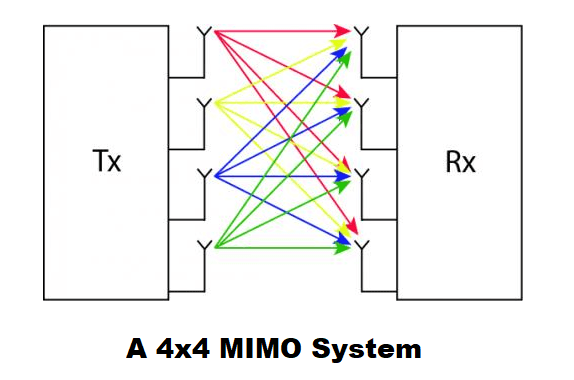
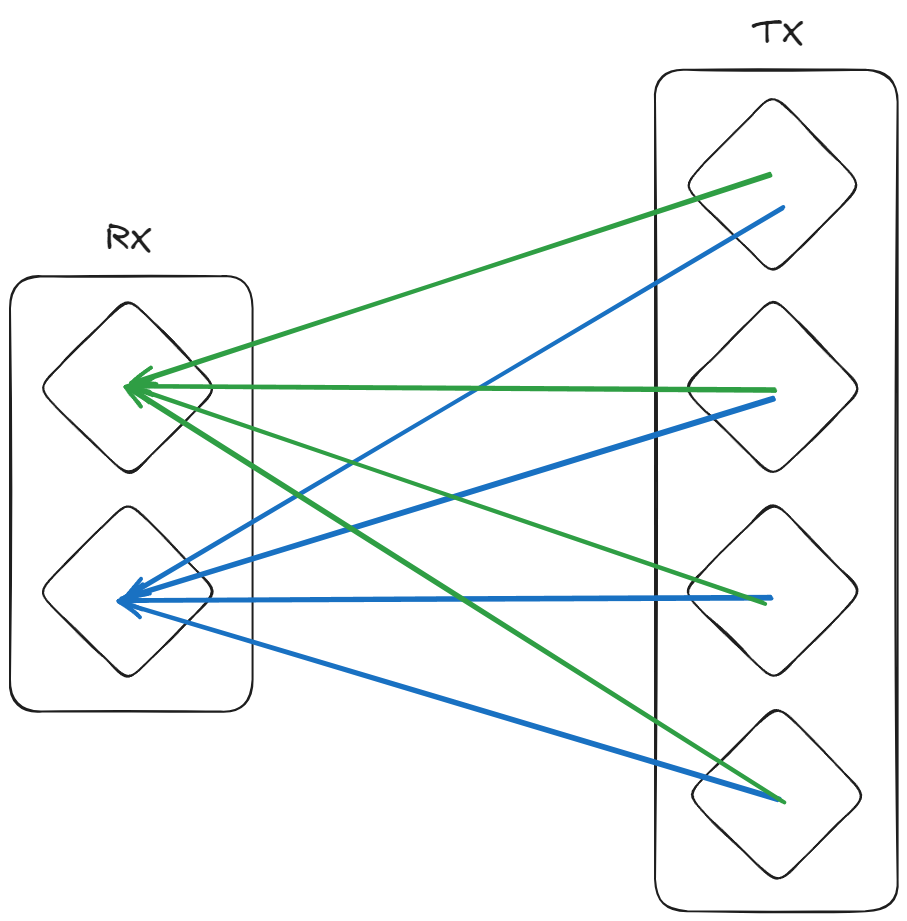
A MIMO system typically consists of transmit and receive antennas. By using the same channel, every antenna receives not only the direct components intended for it, but also the indirect components intended for the other antennas. A time-independent, narrowband channel is assumed.
A possible MIMO system could look as follows ( MIMO):
Relation to Shannon-Hartley
MIMO allows to expand the theoretical bandwidth by increasing the number of transmitters and receivers .
Definition
Link to originalShannon–Hartley Theorem
where:
- is the theoretical maximum rate in bits-per-second (bandwidth) in that channel without transmission reception errors.
- is the number of inputs (transmitters)
- (sometimes ) is the occupied bandwidth in Hz
- is the number of outputs (receivers)
- is the Signal-to-Noise Ratio
Usage
Legacy Wireless Local Area Network (WLAN) systems use omnidirectional antennas that provide good coverage, but don’t concentrate the transmitted power to the intended user. Because of the signal energy being scattered and reflected from objects in the environment, components of the signal arriving at the receiver are spread out over a longer period of the time is desirable.
Problems
The challenge is to provide a high-performance and reliable data link that can operate with:
- restricted power levels
- severe channel fading due to multipath reflections, and
- interfering energy from other devices.
Beams
Beamforming
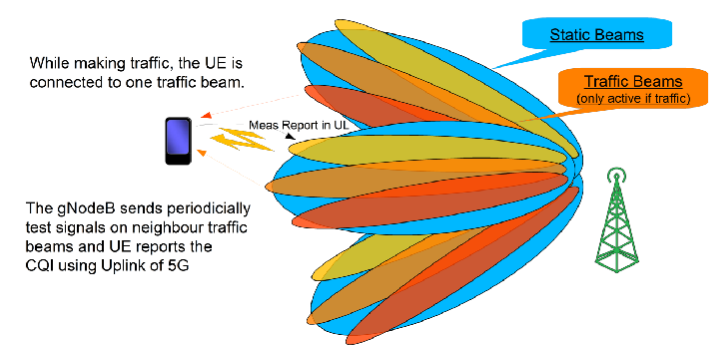
- Beamforming uses the same frequency band multiple times.
- Enables parallel data transmission
- Increases the bandwidth and distance
- Signals are transmitted over multiple (spatial) paths multiple simultaneous data transmissions
Static Beams
Static Beam
Static beams in 5G are predefined, non-adaptive beam patterns used to cover specific geographic areas or sectors without dynamically adjusting to individual user equipment locations or channel conditions. These beams provide a broad and consistent level of coverage but may not optimally address the specific needs of mobile users or adapt to changes in the environment.
- for signalling (transmission of control information between the user equipment and the network infrastructure)
- small bandwidth (designed to carry signals that do not require a large amount of data capacity)
Traffic Beam
Traffic Beam
Traffic beams in 5G are dynamically generated and adjusted beam patterns that specifically target active user equipment, optimising signal quality and data throughput by adapting in real-time to changes in user location and channel conditions. This approach enhances network efficiency and performance, particularly in environments with high user mobility and varying signal obstacles.
- User equipment chooses the best beam and uses it for data transmission
Diversity
Diversity (MIMO)
Diversity in the context of MIMO refers to the technique of using multiple transmit and receive antennas to exploit different propagation paths in the environment, thereby improving the reliability and capacity of wireless communications. It enhances signal quality and reduces the risk of communication failures by combining signals that have undergone different fading characteristics, ensuring more robust and efficient data transmission.
By utilising multiple antennas at both the transmitter and receiver, MIMO systems can achieve diversity in several dimensions:
- Spatial Diversity
- Angular Diversity
- Polarisation Diversity
- Frequency Diversity
- Time Diversity
RX Diversity
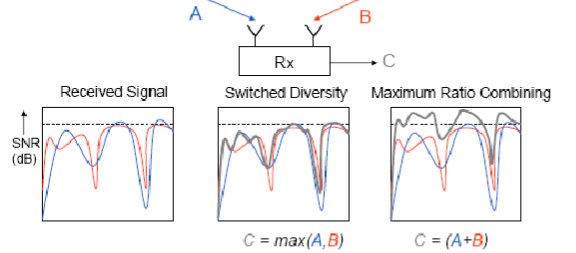
RX diversity uses more antennas on the receiver side than on the transmitter side. The simplest scenario consists of two RX and one TX antenna ( SIMO):
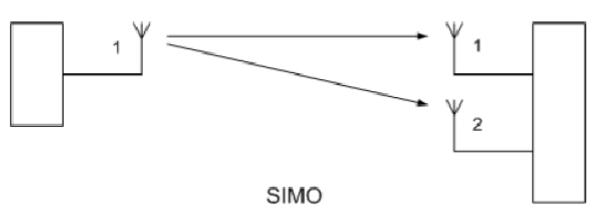
Because of the different transmission paths, the receiver sees two differently faded signals. By using the appropriate method in the receiver, the Signal-to-Noise Ratio can now be increased. Switched diversity always uses the stronger signal, while maximum ratio combining uses the sum signal from the two signals:
TX Diversity
When there are more TX than RX antennas, this is called TX diversity. The simplest scenario consists of two TX and one RX antenna ( MISO):
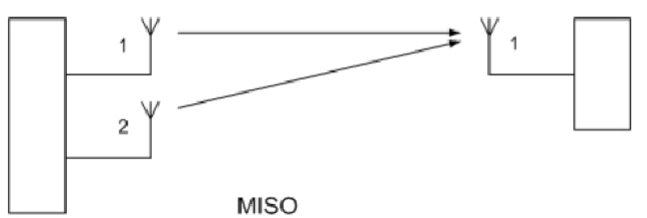
In this case, the same data is transmitted redundantly over two antennas. This method has the advantage that the multiple antennas and redundancy coding is moved from the mobile user equipment to the base transceiver station, where these technologies are simpler and cheaper to implement.
To generate a redundant signal, space-time codes are used. Space-time codes additionally improve the performance and make spatial diversity usable. The signal copy is transmitted not only from a different antenna, but also at a different time. This delay transmission is called delay diversity. This delayed transmission is called delayed diversity.
Variations
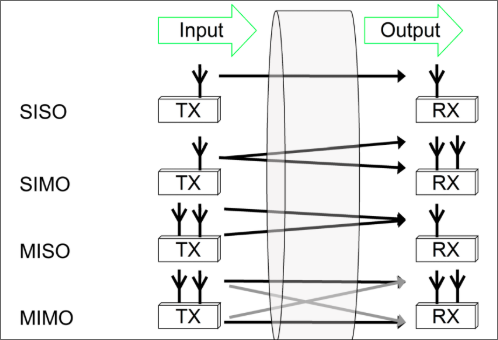
- SISO
- SIMO
- MISO
MIMO vs. SISO
The advantage of MIMO in comparison to SISO is higher bandwidth in bits per second (bps) without increasing the frequency bandwidth in Hz.
This is done by dividing the channel into multiple “spatial channels” through which independent data streams can be transmitted. This technique is also known as “spatial multiplexing” through beamforming.
Additionally, a MIMO system can be used to increase diversity gain, where the Signal-to-Noise Ratio can be increased, up to a maximum of () over a SISO system, where and are the number of antennas (see Shannon–Hartley Theorem).
Exam Question

- Given:
- Convert signal strengths from dBm to Watt (W):
- Compute signal-to-noise ratio:
- Compute MIMO:
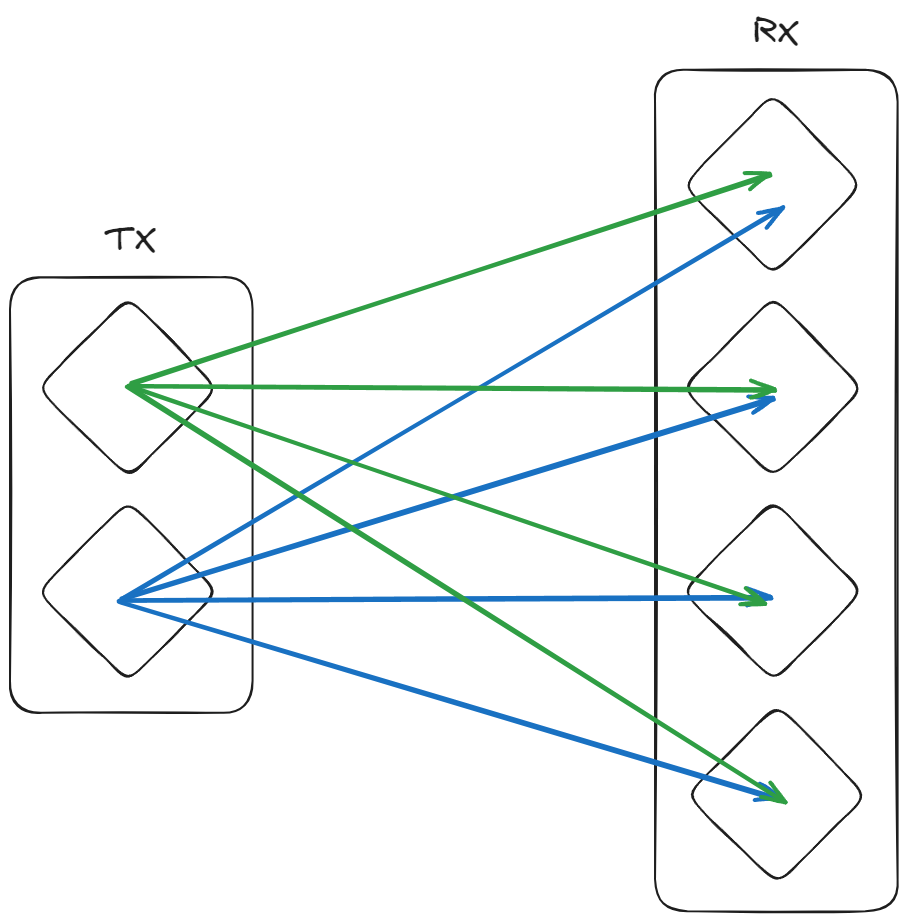
- Compute SISO () bandwidth: